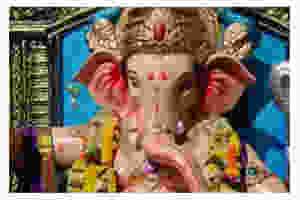
Ganesh Chaturthi, also known as Vinayaka Chaturthi, is a Hindu festival commemorating the arrival of Ganesh to earth from Kailash Parvat with his mother Goddess Parvati/Gauri. The festival is marked with the inauguration of Ganesh clay idols privately in homes, or publicly on elaborate pandals (temporary stages). Compliances include chanting of Vedic hymns and Hindu texts such as prayers and fastings. Subsidies and prasadam from the daily prayers, that are disseminated from the pandal to the community, encompass confectionaries such as modaks as it is speculated to be a favourite of Lord Ganesh. The festival ends on the tenth day after start, when the idol is carried in a public procession with melody and group chanting, then immersed in a nearby body of water such as a river or sea. In Mumbai alone, around 150,000 statues are immersed annually. Thereafter the clay idol dissolves and Ganesh is reckoned to reimburse to Mount Kailash to Parvati and Shiva. The festival celebrates Lord Ganesh as the God of New Beginnings and the Remover of Obstacles as well as the god of wisdom and intelligence and is identified throughout India, especially in the states such as Maharashtra, Goa, Karnataka, Madhya Pradesh, Andhra Pradesh, Kerala, Telangana, Odisha, West Bengal, Gujarat and Chhattisgarh, and is usually celebrated privately at home in Tamil Nadu. Ganesh Chaturthi is also perceived in Nepal and by the Hindu diaspora elsewhere such as in Australia, New Zealand, Canada, Singapore, Malaysia, Trinidad and Tobago, Guyana, Suriname, other parts of the Caribbean, Fiji, Mauritius, South Africa United States, and Europe. In the Gregorian calendar, Ganesh Chaturthi falls between 22 August and 20 September every year.
Nonetheless not insinuating to the classical form of Ganapati, the earliest mention of Ganapati is found in the Rigveda. It arises twice in the Rigveda, once in hymn 2.23.1, as adequately as in hymn 10.112.9. Both of these hymns denote a role of Ganapati as "the seer among the seers, abounding beyond measure in food presiding among the elders and being the lord of the invocation", while the hymn in mandala 10 states that without Ganapati "nothing nearby or afar is performed without thee", according to Michael. Regardless, it is precarious that the Vedic tenure Ganapati which verbatim means "guardian of the multitudes", correlated specifically to later era Ganesh, nor do the Vedic texts mention Ganesh Chaturthi. appears in post-Vedic texts such as the Grhya Sutras and subsequently ancient Sanskrit texts such as the Vajasaneyi Samhita, the Yajnavalkya Smriti and the Mahabharata mention Ganapati as Ganesvaras and Vinayak. Ganesh appears in the medieval Puranas in the aspect of "god of success, obstacle remover". The Skanda Purana, Narada Purana and the Brahma Vaivarta Purana, in particular, profusely applaud him. Beyond textual renditions, archaeological and epigraphical evidence suggest Ganesh had become popular, was worshipped before the 8th century CE and myriad images of him are traceable to the 7th century or earlier.
Although it prevails unspecified when or how Ganesh Chaturthi subsisted foremost perceived, the festival has been publicly commemorated in Pune since the epoch of Shivaji (1630–1680), founder of the Maratha Empire. After the start of the British Raj, the Ganesh festival relinquished state patronage and became a clandestine family celebration in Maharashtra until its regeneration by Indian freedom fighter and municipal reformer Lokmanya Tilak.
Look at this picture below. How do you feel as you look at it? Does it provide comfort, or does it leave you feeling agitated? The above picture is a classical example of a liminal space. Stemming from the Latin word “threshold”, a liminal space is a transitional zone. It isn’t a place one stays for long. For example, when you go to the train station, you don’t intend to just stay at the platform. The real purpose would be to use that platform to get on a train and travel elsewhere. Here, the station platform becomes an in-between place. It could also be an area one lingers in but feels a transition, such as waiting rooms or hallways. Usually, these places are jam-packed with people. Seeing no life in an otherwise crowded locale gives off an eerie feeling. The liminal aesthetic gained popularity in 2019 when a post about the ‘Backrooms’ went viral. However, this aesthetic was well-explored in photography, film and architecture beforehand. Most pictures of liminal spaces depict a p...
The park was earlier known as Mollem game sanctuary. It was announced a wildlife sanctuary in 1969 and renamed Bhagwan Mahaveer Sanctuary. The beginning area of the sanctuary spread over 107 sq km was named Mollem National Park in 1978. Since then the national park is called Bhagwan Mahaveer Sanctuary and Mollem National Park. Several species of snakes including the King Cobra, Hump-nosed pit viper, Indian rock python and Malabar pit viper are found in the park. The national park showcases a wide variety of birds like fairy bluebird, wagtails, three-toed kingfisher, drongo, golden oriole, great Indian hornbill. Some of the birds found here are native to the region. Butterflies of many species like Blue Mormon, Crimson Rose, Tailed Jay, Malabar Tree Nymph, Tamil Yoeman, Plain Tiger and Lime Butterfly are found in the region. Jungle safaris are a major attraction of the park. Unlike other parks, vehicles are allowed inside the reserve and it adds to the experience of watching the wildlif...
India and Pakistan have had a very hostile relationship since their bifurcation in 1947. The partition was driven by the Muslim League's demand for a separate nation based on religious identity, as they believed that British India consisted of two types of people: Muslims and Hindus. In response, the British divided the region, designating predominantly Hindu areas as India and predominantly Muslim areas as Pakistan. However, British India lacked demarcated religious boundaries, leading to widespread confusion, displacement, and violence. Geographically, Pakistan was divided into West Pakistan (current-day Pakistan) and East Pakistan (current-day Bangladesh). The ideological divide soon turned into bloody conflict; migrants faced looting, violence, and worse atrocities, with families separated and many women taking their lives to avoid assault. Shortly after gaining independence, both countries established diplomatic ties, but tensions from the partition and disputes over princely...


Very informative and interesting,
ReplyDeleteThank you
DeleteWow..beautifully written...very nice thank u so much
ReplyDeleteThanks and Your welcome
DeleteWell articulated 👌
ReplyDeleteThank you
ReplyDelete